
Sales Email: rachel@ssbravo.com

Search
Close this search box.

Incoloy A286 1.4980 bolt

The Engineer’s Guide to 1.4980 (Alloy A286) Fasteners: Strength at Extreme Temperatures
In the world of high-performance engineering, standard stainless steel often hits its limit. When projects demand high strength and oxidation resistance at temperatures up to 700°C, engineers turn to 1.4980. Known globally as Alloy A286 (or Alloy 286 / A-286), this iron-based superalloy is a staple in aerospace and power generation.

In this guide, we explore the development, application, and technical manufacturing requirements of UNS S66286 fasteners. Below are other name for 1.4980

  • Alloy A286 (or Alloy 286 / A-286)
  • UNS S66286 (The American Unified Numbering System code)
  • AISI 660 (or Grade 660)
  • X6NiCrTiMoVB25-15-2 (The technical EN chemical designation)
  • Böhler T200 (A common trade name

Table of Contents

How 1.4980 Material Was Developed

Material 1.4980, technically designated as X6NiCrTiMoVB25-15-2, was developed to fill the gap between common austenitic stainless steels and expensive nickel-based superalloys.
The breakthrough came through precipitation hardening (age hardening). By adding Titanium and Aluminum to a Nickel-Chromium-Iron base, metallurgists created a material that could be strengthened via heat treatment. This ensures the alloy remains stable and resists “creep”—the tendency of metals to slowly deform under high stress at high temperatures.

Where 1.4980 Fasteners are Used

Due to its high strength and excellent corrosion resistance, 1.4980 bolts are essential in “hot zones” across several industries:
  • Aerospace: Jet engine assemblies, turbine manifolds, and afterburners.
  • Automotive: Turbochargers, exhaust manifolds, and high-performance engine fasteners.
  • Energy: Gas and steam turbines, and nuclear reactor components.
  • Cryogenics: Because it remains non-magnetic and tough at low temperatures, it is also used in cryogenic storage systems.

How to Process 1.4980 Bolts: Expert Precautions

Manufacturing hex bolts, stud bolts, and threaded rods in Böhler T200 / A286 requires specialized knowledge. Because this alloy is designed for high-temperature strength, it is inherently difficult to machine.
  • Work Hardening: Like most superalloys, 1.4980 work-hardens rapidly. You must use positive rake angles and keep the tool cutting constantly to avoid glazed surfaces.
  • Tooling: Use carbide-tipped tools with high-pressure coolant. Slow speeds and heavy feeds are the secret to success.
  • Threading: For socket head cap screws, thread rolling is preferred over cutting. Rolling improves the fatigue life of the bolt, which is critical for high-vibration aerospace environments.
  • Coolant: Use sulfur-free lubricants to prevent surface contamination that could lead to cracking during later heat treatment.

Chemical and Mechanical Specifications

Technical Data: 1.4980 (Alloy A286)

Chemical Element Percentage (%)
Nickel (Ni) 24.0 – 27.0
Chromium (Cr) 13.5 – 16.0
Titanium (Ti) 1.90 – 2.30
Molybdenum (Mo) 1.00 – 1.50
Vanadium (V) 0.10 – 0.50
Mechanical Property Value (Aged)
Tensile Strength (Rm) ≥ 900 MPa
Yield Strength (Rp 0.2) ≥ 590 MPa
Hardness (Brinell) 248 – 341 HBW

Does 1.4980 Need Heat Treatment?

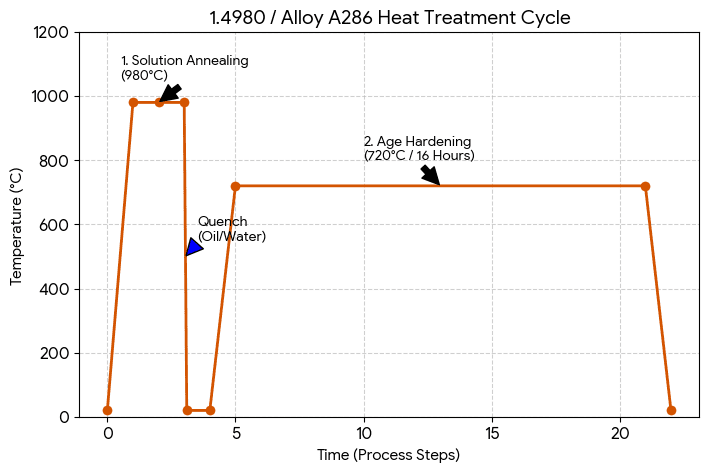
Yes. Heat treatment is the most important step in the manufacturing of Alloy A286 fasteners. Without it, the material remains soft and lacks the high-temperature strength it is famous for.
The process typically involves two stages:
  1. Solution Annealing: Heating to approx. 980°C and quenching. This “resets” the grain structure.
  2. Precipitation Hardening (Age Hardening): Heating to approx. 720°C for 16 hours and air cooling. This stage allows the titanium-rich particles to “precipitate,” giving the stud bolts and threaded rods their final high-strength properties.


  1. 1.4980 bolt

Heat Treatment Parameters for 1.4980 Fasteners

Process Stage Temperature Duration Cooling Method
Solution Annealing 980°C ± 10°C 1 – 2 Hours Oil, Water, or Rapid Air
Precipitation Hardening (Aging) 720°C ± 10°C 16 Hours Air Cooling

*Note: For ASTM A453 Grade 660 Class A/B, the aging process is critical to achieving the required 900+ MPa tensile strength.


Frequently Asked Questions (FAQ)

Q: Is 1.4980 magnetic?
A: In the solution-annealed and aged condition, Alloy A286 remains non-magnetic, making it suitable for sensitive electronic or cryogenic applications.
Q: What is the equivalent ASTM standard for 1.4980 bolts?
A: The most common equivalent is ASTM A453 Grade 660.
Q: Can I use 1.4980 for exhaust manifold bolts?
A: Yes! Because of its resistance to thermal cycling and oxidation, it is the top choice for automotive and marine exhaust systems.
Q: Why choose A286 over Inconel 718?
A: Alloy A286 is more cost-effective. While Inconel 718 handles higher temperatures, A286 is perfect for applications up to 700°C at a lower price point.

Installation and Torque Procedures for 1.4980 Alloy A286 Fasteners

Proper installation of 1.4980 / Alloy A286 fasteners is just as important as the manufacturing process. Because these bolts are often silver-plated or coated with dry film lubricants, their friction coefficients are much lower than standard steel.
Step-by-Step Installation Procedure
  1. Inspection: Check threads of stud bolts and threaded rods for nicks or burrs. A286 is sensitive to stress concentrations.
  2. Cleaning: Ensure the internal mating threads are clean. If the bolt is not pre-lubricated (plain finish), apply a high-temperature anti-seize compound.
  3. Alignment: Align the flange or component perfectly. Socket head cap screws should never be used to “force” parts into alignment, as this causes bending stress.
  4. Snug Tightening: Tighten all bolts in a “star pattern” to roughly 30% of the target torque.
  5. Final Torque: Increase in increments (60%, then 100%) using a calibrated torque wrench.
Email
Email:rachel@ssbravo.com
WhatsApp
WhatsApp Me
WhatsApp
WhatsApp QR Code
(0/8)